
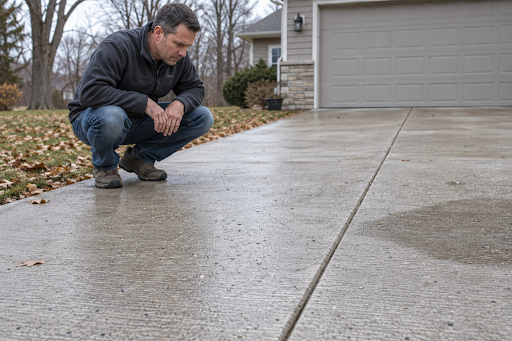
Concrete sealing before a Minnesota winter should begin with an assessment of the surface, its existing treatment, and the weather window available for the work. If you’re looking at your Twin Cities driveway and wondering whether another coat of sealer will help protect it through winter, the answer depends on more than the month on the calendar.
Minnesota concrete faces repeated exposure to moisture, freezing temperatures, snow removal, and deicing materials. A compatible sealer may be one part of a maintenance plan, but it cannot correct settlement, poor drainage, significant deterioration, or other underlying problems.
At Kali Concrete, we encourage property owners to understand the condition of their concrete before choosing a treatment. In some cases, maintenance may be appropriate. In others, the condition of the slab may make a repair or replacement conversation more useful.
Check the Concrete Before Sealing
Start with a careful inspection of the surface.
Look for cracks, flaking, scaling, uneven panels, deteriorated edges, discoloration, and areas where an existing coating appears cloudy or is peeling. Pay particular attention to places that regularly remain wet or collect water after rain.
Those observations can help distinguish a routine maintenance question from a larger concrete or drainage problem.
Cracks should also be considered individually. A small surface crack and a slab that has noticeably shifted don’t necessarily point to the same issue. If sections of a driveway, patio, walkway, or stoop have moved, sealing the surface won’t return those sections to their original position.
Take photographs of questionable areas so you have a record of their condition before winter.
Identify Previous Treatments
If possible, determine when the concrete was installed and whether it has previously been sealed or coated.
Existing treatments matter because a new product needs to be appropriate for both the concrete and any material already on the surface. Applying another product without understanding what is underneath can contribute to appearance, compatibility, or adhesion problems.
If you don’t know what was previously used, mention that before proceeding with another treatment rather than assuming every concrete sealer can simply be applied over the existing surface.
Older concrete may also have received several different treatments over its lifetime, making an evaluation particularly useful before adding another layer.
Look for Drainage and Movement Problems
Water is an important consideration going into a Minnesota winter.
Walk around the concrete after rain and note where water collects. Standing water can indicate drainage, grading, or slab-position issues that a surface sealer won’t correct.
The same applies to movement. If one panel has settled or lifted relative to another, the underlying condition should be considered separately from surface maintenance.
This distinction can prevent you from spending time and money treating the appearance of a problem while leaving its primary cause unaddressed.
If your driveway or other concrete has significant deterioration, movement, or recurring water problems, discuss those conditions before focusing on a new finish. Kali Concrete can help you evaluate whether a replacement conversation makes more sense than another surface treatment.
Allow Time for Cleaning and Preparation
Concrete sealing isn’t simply a matter of opening a container and spreading the product across the driveway.
The surface needs to meet the preparation requirements of the selected product. Dirt, contamination, moisture, loose material, and remnants of incompatible previous treatments can affect the finished result.
Preparation requirements vary depending on the concrete and product being used.
This is another reason to avoid waiting until the last possible fall weekend. If the concrete needs additional cleaning, drying, or preparation, there needs to be enough time to complete those steps before weather conditions change.
Respect the Sealer’s Weather Requirements
Minnesota fall weather can make scheduling concrete work tricky.
A warm afternoon doesn’t necessarily mean the entire application and curing period provides suitable conditions. Surface temperature, air temperature, moisture, rain, and the expected conditions after application may all matter.
Different products have different requirements, so follow the manufacturer’s instructions for the specific material being used.
Ask whoever performs the treatment to explain the required preparation, application conditions, drying or curing period, and when foot or vehicle traffic can safely resume.
Avoid treating an approaching winter as a reason to apply a product outside its specified conditions. If the appropriate weather window has passed, waiting for suitable conditions may be the better option.
Understand What a Sealer Cannot Fix
A concrete sealer shouldn’t be treated as a universal solution for every driveway or patio problem.
It won’t correct a slab that has settled, restore deteriorated concrete, change an improper slope, or eliminate a drainage problem. It also doesn’t replace appropriate maintenance and winter care.
If you’re seeing substantial deterioration, repeated movement, or sections that continually collect water, those conditions deserve their own evaluation.
Understanding that distinction can help you choose between maintaining an otherwise serviceable surface and considering more extensive concrete work.
Prepare the Area for Application
If sealing is appropriate, think about how the area will be used while the work is completed.
Vehicles may need to be moved from a driveway, and patios or walkways may need to remain free of furniture and other belongings. Make sure household members know which areas cannot be used during application and curing.
Ask when normal traffic can resume rather than estimating based on how dry the surface appears.
Planning access becomes especially important if the treated driveway is your primary parking area or if a walkway provides an important entrance to the property.
Plan Winter Care Beyond the Sealer
Preparing concrete for winter doesn’t end once a sealer has been applied.
Snow removal, moisture, freeze-thaw exposure, and deicing practices can all affect concrete over time. Care recommendations may also vary depending on the age and finish of the concrete.
National Ready Mixed Concrete Association guidance advises avoiding deicing chemicals during the first winter and using them moderately afterward.
Don’t assume that a product marketed as safe for concrete is appropriate for every surface, finish, or age. Follow applicable concrete and product guidance and consider how you’ll address traction without relying unnecessarily on large amounts of deicing material.
Snow-removal practices matter as well. Plows, shovels, snowblowers, and other equipment should be used carefully around vulnerable edges, joints, steps, and transitions.
Keep Track of Changes Through the Winter
A simple record can make spring evaluation easier.
Photograph cracks, surface deterioration, uneven sections, and drainage concerns before winter begins. When the snow and ice are gone, compare those areas with the earlier photographs.
If a crack has widened, deterioration has progressed, or movement has become more noticeable, you’ll have a better reference for discussing what changed.
This is particularly useful for problems that develop gradually and can otherwise be difficult to judge from memory.
Use a Fall Concrete Review Checklist
Before winter arrives:
- Note cracks, flaking, scaling, uneven areas, and standing water.
- Gather the installation date and previous sealing information when available.
- Photograph areas you want to monitor.
- Determine whether the concern appears to be maintenance or an underlying condition.
- Confirm product compatibility and preparation requirements before sealing.
- Check the required application and curing weather conditions.
- Plan vehicle, pedestrian, and property access during the work.
- Review winter care and snow-removal practices.
Taking these steps doesn’t guarantee that concrete will avoid every effect of a Minnesota winter, but it gives you a more informed basis for deciding what maintenance or additional work makes sense.
Talk With Kali Concrete About Your Concrete
Kali Concrete is a family-owned company serving Minneapolis, St. Paul, and the surrounding Twin Cities metro area.
If your fall inspection raises questions about the condition of a driveway, patio, stoop, or walkway, contact Kali Concrete at 612-247-2565 or request a quote. Include photographs of problem areas and mention recurring standing water, movement, cracking, or deterioration you’ve observed.
We can discuss the condition of the concrete, your priorities, and whether replacement should be considered rather than treating another surface coating as the answer to every problem.