
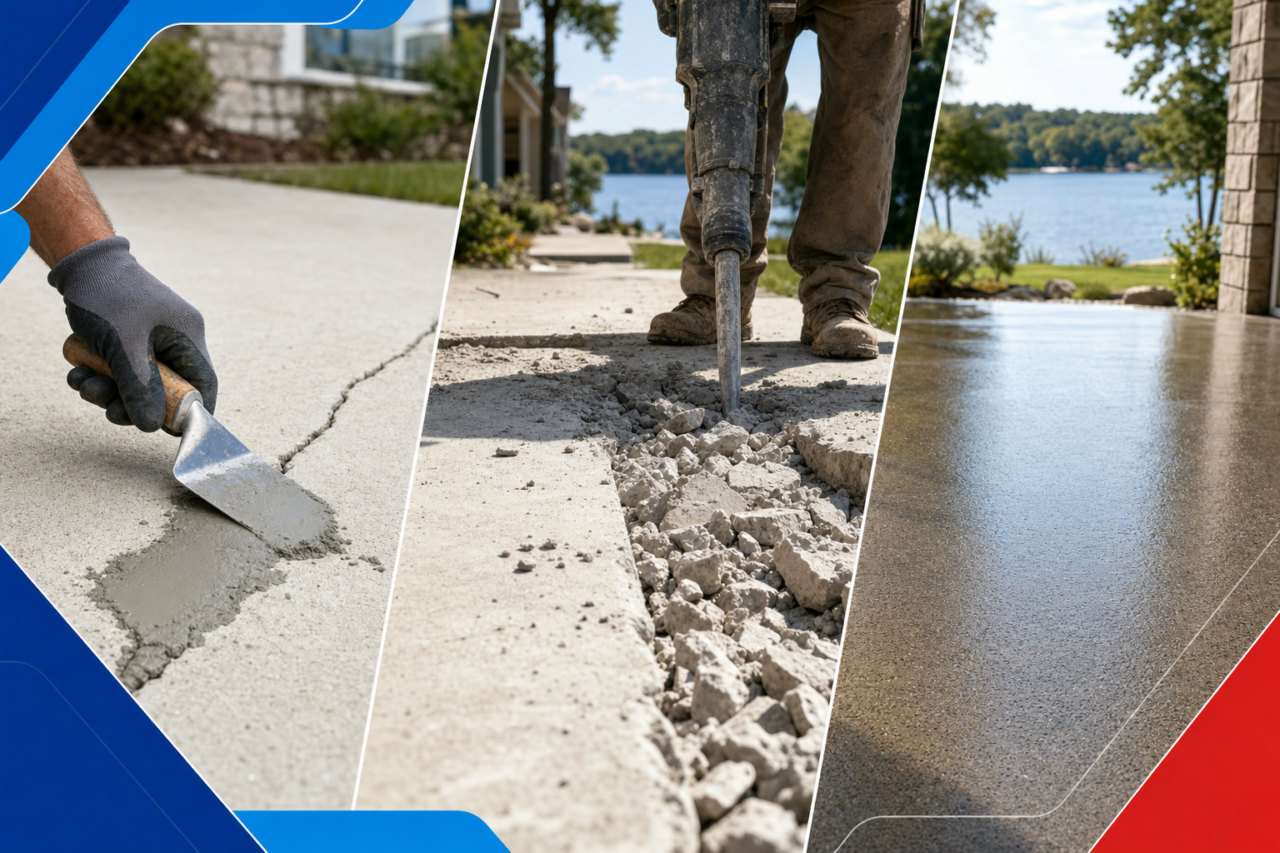
The choice between concrete repair vs replacement vs sealing starts with five factors: the surface’s present condition, what may be contributing to the damage, whether the condition is changing, how the area will be used, and what upkeep the selected option will require. Sealing may protect serviceable concrete, while movement, recurring water, displacement, or widespread deterioration can justify a broader site evaluation.
TL;DR: How to Compare the Options
- Choose a scope only after assessing damage, movement, water behavior, intended use, and site access.
- Sealing protects suitable concrete but cannot correct settlement, displacement, or drainage problems.
- Compare prevention, localized repair, surface renewal, replacement, and deliberate delay.
- Evaluate total scope, future upkeep, disruption, deferral risk, and applicable warranty terms—not initial price alone.
- Bring photographs, approximate dimensions, current conditions, intended use, and access constraints to the first consultation.
Maintenance, Repair, or Replacement? Start With the Cause
Define the project’s objective before selecting a treatment. Protecting sound decorative concrete, closing an isolated damaged area, improving appearance, removing a trip concern, addressing recurring water, and preparing for heavier use are different goals.
Use this five-question framework to organize the decision:
- What has changed? Record cracking, surface wear, settlement, displacement, standing water, scaling, spalling, failed patches, and other visible deterioration.
- Does it appear stable? Compare the condition with older photographs or take new dated photographs from repeatable positions. A changing crack or offset deserves more scrutiny than a cosmetic condition that has remained consistent.
- What conditions may be relevant? Water flow, repeated loading, nearby structures, adjoining slabs, site access, and movement can affect the appropriate scope. Treat these observations as information for an evaluation rather than a diagnosis.
- How will the area be used? Vehicle traffic, pedestrian access, equipment, and commercial activity place different demands on a surface.
- What upkeep is realistic? Include cleaning, monitoring, winter care, crack attention, and resealing where applicable in the decision.
Apply the same objective and site facts to every proposal. That makes it easier to see whether two quotes solve the same problem or merely carry different prices.
Step 1: Document the Existing Concrete and Its Intended Use
You do not need to diagnose the concrete before contacting a contractor. You need enough information to explain what is happening and what the project should accomplish. Kali Concrete asks prospective customers to describe cracks, settling, drainage concerns, and materials that may require removal. Its inquiry guidance also asks about intended use and site details that could affect access or planning.
Walk the Entire Surface, Not Just the Worst Area
Inspect the perimeter, joints, edges, steps, transitions, and connections to other paved areas. Take close-up photographs of damage and wider photographs that show how the area relates to slopes, downspouts, landscaping, structures, and adjoining slabs.
Record these observations:
- Cracks: Note location, direction, approximate length, and whether the two sides remain level. Photograph cracks that intersect or continue through multiple areas.
- Movement or settlement: Look for low spots, tilted slabs, raised edges, separation, or changes where concrete meets a garage floor, step, curb, or walkway.
- Joint condition: Identify damaged joint edges, debris-filled joints, and cracks occurring near or away from intended joints.
- Water behavior: After rain or normal water use, document standing water, runoff paths, splash zones, and areas that remain wet longer than the surrounding surface.
- Surface condition: Photograph flaking, scaling, spalling, worn texture, exposed material, stains, coatings, and previous repairs.
- Safety: Identify abrupt height differences, unstable transitions, or damage along normal pedestrian, vehicle, or equipment routes.
- Extent: Distinguish one limited defect from deterioration appearing across multiple slabs or most of the surface.
If you plan to monitor rather than act immediately, repeat the photographs from the same positions and set a reassessment date. This provides more useful information than relying on memory.
Describe the Future Use and Site Constraints
A patio used for seating, a driveway carrying vehicles, a walkway serving frequent pedestrian traffic, and a commercial surface used by equipment require different planning. Record who or what will use the area, where traffic enters and turns, and whether that use will change after construction.
Also identify gates, landscaping, utilities, nearby structures, narrow passages, and surfaces that must remain accessible. Note any materials that may need removal and any scheduling or access concerns. For example, a decorative update may also need to preserve landscaping, fit through restricted access, and maintain a route to an entrance. Those conditions should be discussed before choosing a finish.
Step 2: Compare Prevention, Repair, Surface Renewal, Replacement, and Delay
Each option should be matched to the problem it is meant to address. The central boundary is straightforward: sealing, patching, or covering a surface should not be treated as a correction for unresolved movement, settlement, water management, or unsuitable underlying conditions.
Routine Prevention and Sealing
Prevention is most relevant when the concrete is generally performing as intended and the goal is to manage exposure and preserve its condition. Cleaning, monitoring, early attention to small cracks, appropriate winter practices, and sealing where applicable may be part of that plan. Before proceeding, confirm that the concern is protective or cosmetic rather than a changing functional problem. Sealer cannot level a settled slab, remove a trip hazard, or redirect recurring water.
Localized Repair
A localized repair may be worth evaluating when damage is confined to a crack, joint, edge, or limited area and the surrounding surface remains a reasonable candidate for continued use. Ask whether the repair is intended to improve appearance, protect a damaged location, or address a functional concern. Confirm how it may differ from the existing concrete in color and texture, and what the next step would be if movement or damage returns.
Resurfacing or Overlay Work
Surface renewal may be considered when the exposed surface needs improvement without automatically removing all existing concrete. The key question is whether the current surface is suitable for the proposed system. Ask what preparation is included, which defects must be treated first, how existing cracks will be handled, and what maintenance the renewed surface will need. Reduced removal does not make an overlay suitable for settled, displaced, or repeatedly moving concrete.
Removal and Replacement
Replacement creates an opportunity to remove existing concrete and plan a new installation around current use, access, water behavior, adjoining surfaces, and finish preferences. It deserves evaluation when deterioration is widespread, multiple areas have moved, previous treatments keep failing, the layout or use is changing, or a surface treatment would leave the primary concern unresolved.
The tradeoff is a broader construction scope. Compare removal and disposal needs, access for work, effects on landscaping or adjacent structures, and temporary disruption to entrances, parking, pedestrian routes, or business activity.
Delaying the Work
Deferral can be reasonable when a concern appears stable, primarily cosmetic, and compatible with safe use and water management. It is less attractive when a height difference, recurring standing water, unstable transition, or expanding damaged area could increase the eventual scope or interfere with use.
Make delay an active monitoring choice. Keep dated photographs, record water behavior, set a review date, and decide what change—such as additional movement, a returning repair, or a growing trip concern—will trigger an evaluation.
Conditions That Need More Than Simple Maintenance
Color variation, staining, or limited surface wear may primarily affect appearance. The following conditions warrant closer evaluation before choosing sealing, patching, or an overlay:
- Cracks that appear to be growing, widening, or returning after treatment
- One side of a crack or joint sitting higher than the other
- Slabs that have visibly settled, tilted, or separated
- Standing water or repeated runoff through a damaged area
- A trip hazard or unstable transition along a normal walking route
- Deterioration across multiple sections rather than one isolated location
- Damage where vehicles or equipment repeatedly load the surface
- Previous patches or coatings that are failing again
- A planned change in use that may place different demands on the area
These signs identify what needs investigation; they do not establish a cause or prescribe a particular treatment.
Include connected surfaces in that investigation. Replacing or repairing one slab without considering adjoining pavement, steps, garage entries, structures, and runoff paths can leave transitions unresolved. Set the project boundary around the condition and objective rather than around the smallest area that can receive a preferred treatment.
Build a Long-Term Value Comparison Before Approving a Quote
Use the same worksheet for every option so that sealing, repair, renewal, and replacement proposals can be compared on equivalent terms.
- Problem and proposed outcome: State what the option is expected to address. A scope focused on appearance is not equivalent to one intended to address access, displacement, or water behavior.
- Current scope and exclusions: List preparation, removal, disposal, site protection, materials, finish, sealing where applicable, cleanup, and restoration. Mark every item that is excluded or dependent on site conditions.
- Future work and upkeep: Compare cleaning, crack monitoring, resealing, winter care, possible repeat repairs, and the conditions that could require a broader intervention later.
- Disruption and deferral risk: Account for effects on entrances, parking, pedestrian routes, equipment access, landscaping, utilities, and scheduling. Then document what could happen if the work is postponed.
- Applicable warranty terms: Identify which product or material terms apply, what they cover, their exclusions, and any maintenance or recordkeeping requirements.
Kali Concrete states that applicable product and material warranties are provided by its vendors and that relevant warranty information is explained during the final walk-through. Coverage can vary by product, material, and scope, so request the terms that apply to the specific option under consideration.
Test Important Assumptions
If a repair proposal assumes the surrounding surface is stable, ask how that will be evaluated. If replacement pricing assumes open equipment access, disclose gates, landscaping, utilities, structures, and narrow areas. If the project includes a decorative finish, confirm its maintenance requirements before comparing it with another finish.
Review three possible scenarios:
- Expected case: The treatment performs as intended with the stated maintenance.
- Higher-maintenance case: Additional crack attention, resealing, or localized work becomes necessary.
- Scope-change case: Site evaluation identifies movement, drainage, access, or removal needs that require a broader plan.
This comparison reveals whether an option’s value depends on optimistic assumptions and whether differences in initial price remain meaningful after upkeep and disruption are considered.
Plan Prevention Into a New Concrete Project
For decorative residential flatwork, Kali Concrete recommends periodic cleaning, early attention to small cracks, avoiding harsh de-icing agents, and applying sealer every two to three years. Its driveway guidance also says resealing every two to three years can help protect against moisture intrusion and reduce the chance of cracking during Minnesota freeze-thaw cycles, particularly for stamped, textured, or colored concrete.
That is Kali Concrete’s stated guidance for the relevant surfaces, not a universal schedule for every product or condition. Confirm the appropriate maintenance plan for the surface, finish, exposure, and materials included in your project.
Confirm Maintenance Before Selecting a Finish
Kali Concrete’s described stamped-concrete process includes surface preparation, rebar, pouring, application of the selected pattern or textured skin, and sealant. When considering that type of finish, confirm both the installation scope and the later maintenance requirements.
- Is sealer included in the initial scope, and where will it be applied?
- What surface changes indicate that resealing should be discussed?
- How will the selected texture affect cleaning or snow-removal practices?
- Which de-icing products or practices should be avoided?
- What should the owner do if a small crack or damaged area appears?
- Does an applicable product warranty require particular maintenance or records?
Questions to Resolve Before Moving Forward
After documenting the site and comparing the available paths, use the consultation to resolve details that cannot be answered from photographs alone:
- Which quoted work is included, excluded, or dependent on conditions found during preparation or removal?
- Does the proposed scope address the main project objective or only improve the visible surface?
- How will repaired or renewed areas differ from existing concrete in color, texture, and overall appearance?
- How will adjoining slabs, structures, entrances, and runoff paths affect the project boundary?
- What access will the crew need, and which areas will be unavailable during the work?
- What maintenance should begin after installation, and when should the surface be reassessed?
- Which product or material warranty terms apply to this exact scope?
Clear written inclusions and exclusions make competing proposals easier to compare and reduce the chance that two substantially different scopes will be treated as equivalent.
Request a Concrete Project Evaluation in Prior Lake
Once you have completed the condition and site inventory, use it to provide Kali Concrete with the job location, project objective, approximate dimensions, and available photographs. Exact measurements and final finish decisions do not need to be completed before the first conversation.
Kali Concrete describes its process as an initial phone consultation, an in-person consultation or site visit, construction, and a final walk-through. The company lists Prior Lake among the Twin Cities communities it serves and states that it has provided concrete paving services to residential and commercial customers in the Minneapolis/St. Paul Metro area for more than 40 years.
Contact Kali Concrete to discuss whether a new installation or replacement project fits your goals and site conditions. If your project involves a vehicle surface, review Kali Concrete’s concrete driveway options before your consultation.
Frequently Asked Questions
Can a cracked surface still be sealed instead of replaced?
Possibly. The decision depends on the crack’s condition, whether movement or displacement is present, how water behaves around the area, and the condition of the surrounding concrete. Sealing may protect a suitable surface, but it does not level settled concrete or correct continuing movement.
How can I compare a repair quote with a replacement quote?
Ask each contractor to identify the problem addressed, preparation and removal included, expected maintenance, exclusions, access disruption, and conditions that could require more work later. The quotes should not be compared by price alone if they cover different objectives or project boundaries.
What information should I send when requesting a concrete estimate?
Provide the job location, approximate dimensions, photographs, project objective, visible cracks or settling, drainage concerns, intended vehicle or pedestrian use, materials requiring removal, and relevant access details.