
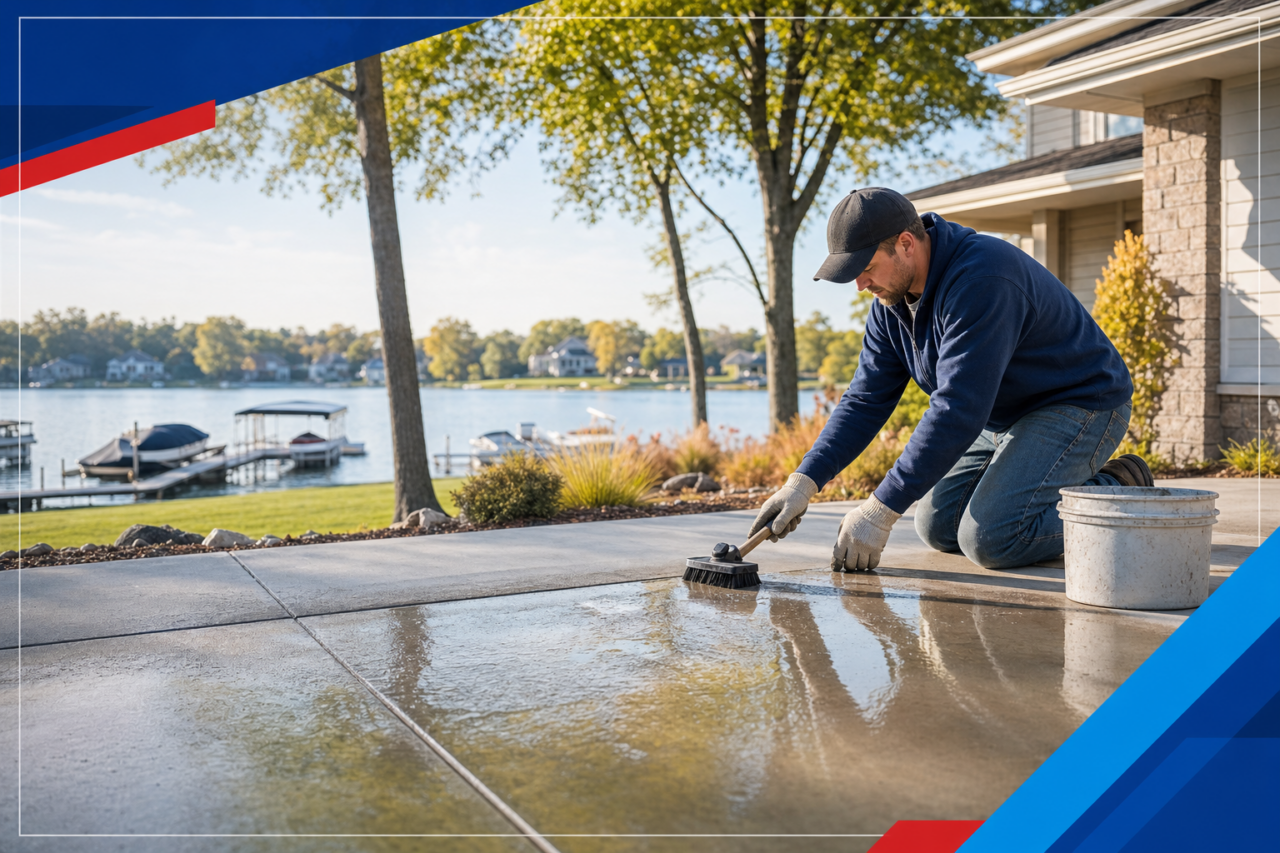
The practical priorities for exterior concrete in Prior Lake are straightforward: observe how water moves, inspect surfaces after winter, and use maintenance practices suited to Minnesota weather. Snowmelt, heavy rainfall, freeze-thaw exposure, and winter snow removal all affect what homeowners should watch on driveways, patios, pool decks, stoops, and walkways.
This concrete maintenance guide for Prior Lake, MN homeowners provides a four-season schedule, surface-specific checks, and a decision framework for moving from observation to maintenance, evaluation, or replacement planning.
TL;DR: Five Concrete Maintenance Priorities
- Follow the water: Check where rain, downspout discharge, and snowmelt travel and collect.
- Inspect after winter: Look for new cracks, opening joints, flaking, loose material, chipped edges, and elevation changes.
- Use gentler winter practices: Kali Concrete recommends avoiding harsh deicing agents and using a plastic shovel or plow.
- Account for the surface: Vehicle traffic, decorative finishes, barefoot use, and pedestrian transitions create different priorities.
- Use changes to guide action: A stable cosmetic condition and a shifting slab should not receive the same response.
Why Minnesota Conditions Change a Concrete Maintenance Plan
Concrete maintenance in Minnesota is closely tied to moisture management and seasonal observation. Kali Concrete identifies harsh freeze-thaw cycles as an important driveway-performance consideration. University of Minnesota climate guidance also identifies snowmelt and heavy rainfall as relevant drainage and flooding concerns for Minnesota homeowners.
Moisture can reach cracks, joints, surface defects, and the areas alongside a slab. Repeated freezing and thawing can add stress to vulnerable areas. A crack visible in spring should not automatically be blamed on one winter event, however. Its location, rate of change, nearby runoff, and any difference in slab elevation provide more useful decision-making context.
Learn what different surface changes mean for the next decision
Homeowners often group every concrete condition under the word cracking, but the visible form changes what should be checked next:
- A crack is a break through part of the concrete surface. Determine whether it is new, widening, holding water, or accompanied by vertical movement.
- Scaling appears as flaking or loss of a thin surface layer. Note whether it remains isolated or continues to spread.
- Spalling generally describes deeper chipping or breakage that leaves a rough or recessed area. Damaged edges and corners can be particularly vulnerable to snow-removal impacts.
- Joint deterioration may appear as opening, crumbling, trapped debris, vegetation, or failed material around an intended joint.
- Settlement or heaving involves a change in elevation and can affect both runoff and safe use.
These observations are not a diagnosis. They establish whether a homeowner is dealing with appearance, surface deterioration, water exposure, or apparent movement. A stained but level surface calls for a different conversation than a walkway panel that has shifted enough to catch a shoe.
Winter products and tools add another variable
Winter prevention involves both product choice and technique. Repeated impacts from a hard edge can chip a vulnerable corner, while harsh chemicals and deicing agents may add to surface exposure. Kali Concrete advises driveway owners to avoid harsh deicing agents and use a plastic shovel or plow to help protect concrete edges.
A Four-Season Concrete Maintenance Calendar
Use weather conditions rather than a fixed calendar date. Begin the spring inspection after snow cover recedes and surfaces can be viewed safely. Complete fall preparation before freezing conditions and heavy snow limit cleaning and inspection.
Spring: Inspect after the thaw
- Walk every surface. Check the driveway, patio, pool deck, stoops, walkways, garage approach, and foundation-adjacent concrete.
- Look for changes. Note new cracks, opening joints, flaking, loose material, chipped edges, and differences in elevation.
- Check runoff during a thaw or rain. Identify water crossing the slab, collecting in low spots, or remaining near the foundation.
- Remove winter debris. Clear leaves, grit, and other material that may conceal surface wear or block an intended drainage path.
- Flag urgent use concerns. Identify steps, transitions, and pedestrian panels that no longer feel safe underfoot.
Use the five-point runoff check later in this guide if water repeatedly collects or follows an unexpected path.
Summer: Clean and plan appropriate maintenance
Warm-weather months provide a practical opportunity to clean concrete and consider crack, joint, or sealing maintenance. Cleaning also makes it easier to distinguish dirt or staining from flaking, loose material, and actual openings.
Kali Concrete recommends cleaning patios every month or two, watching for small cracks, and applying sealer every two to three years. It also recommends considering driveway resealing every two to three years, particularly for stamped, textured, or colored surfaces. These intervals are Kali Concrete’s company guidance rather than universal requirements. Existing products, exposure, wear, finish, current condition, and product-label instructions should inform actual timing.
Fall: Prepare surfaces and drainage paths
- Clear leaves and debris from concrete, gutters, downspouts, and visible runoff paths.
- Check where downspouts discharge in relation to slabs and the foundation.
- Move planters, furniture, or other items that could trap moisture or conceal a surface through winter.
- Identify step edges, decorative borders, previous damage, and other areas snow-removal operators should avoid striking.
- Address unresolved project questions while the concrete and surrounding site remain visible.
- Review labels and restrictions for any products being considered for winter use.
If repair or replacement may be needed, fall observations can help clarify removal, access, drainage, finish, and scheduling considerations before snow conceals the site.
Winter: Reduce avoidable edge and surface damage
Use a plastic shovel or appropriately configured plow, and avoid striking slab edges, corners, steps, or decorative borders. Kali Concrete also recommends avoiding harsh chemicals and deicing agents. If a snow-removal service works on the property, identify vulnerable transitions before the first major snowfall.
Choose snow-storage areas with the eventual melt path in mind. If concentrated meltwater later crosses a walkway, gathers in a recurring low spot, or moves back toward the house, include that observation in the runoff review.
Surface-by-Surface Concrete Prevention
The seasonal calendar applies across exterior flatwork, but each surface has a distinct use-related priority.
Driveways: Vehicle paths and transitions
Inspect wheel paths, edges, the garage approach, and transitions to adjoining pavement. Note depressions that repeatedly hold rainwater or snowmelt, as well as damage where a plow or shovel contacts the slab. Kali Concrete’s concrete driveway service information provides additional construction and maintenance context.
Patios: Concealed areas and recurring dampness
Dirt, planters, furniture, and organic debris can conceal small cracks or keep part of a patio damp. Periodically expose the full surface, including the edge closest to the house and areas affected by roof runoff or landscaping. Homeowners considering a new or replacement surface can review Kali Concrete’s concrete patio options.
Stamped, textured, and colored concrete: Product compatibility
For decorative concrete, keep the names and dates of previous cleaning and sealing products. Kali Concrete notes that regular sealing can be especially important for stamped, textured, or colored surfaces. Preparation and compatibility matter, so identify an existing coating before applying another product. See the company’s stamped concrete services for more finish-specific information.
Walkways and stoops: Pedestrian transitions
Check connections between panels, step edges, and transitions to a driveway or patio. A narrow cosmetic crack in a level panel is different from a vertical change that catches a shoe. Kali Concrete’s concrete stoops and walkways page offers related service information.
Pool decks: Barefoot use and loose material
Pool decks combine frequent water exposure with barefoot traffic. Keep the walking surface clear enough to spot cracks, loose material, chipped areas, and elevation changes. Product compatibility also matters when the deck has a decorative finish. Learn more about Kali Concrete’s concrete pool decks.
Foundation-adjacent concrete: Runoff direction
For patios, stoops, and walkways near the house, focus on the direction water travels. Observe whether runoff moves toward the foundation, enters the area between the structure and slab, or collects near a downspout outlet.
Drainage and Runoff: Check the Site Before Blaming Only the Slab
A visible concrete condition can be part of a larger water-flow pattern. Homeowners can gather useful, non-diagnostic information by observing the site during spring thaw, steady rain, or a heavier rainfall event.
Use the five-point runoff check
- Source: Where does the water begin? Look at roof runoff, downspouts, landscaping, snow piles, and higher paved areas.
- Path: Does it cross a driveway, follow a slab edge, or travel toward a stoop, patio, or foundation?
- Collection: Where does it stop? Record recurring puddles, saturated edges, and wet areas that remain after nearby surfaces dry.
- Change: Is the pattern new, or has a low area become more noticeable over time?
- Consequence: Does the water coincide with widening damage, loose material, refreezing, an uneven section, or impaired use?
Include wide-angle photographs that show the slab in relation to the house, downspout, landscaping, and surrounding surfaces. A short video taken while water is moving may communicate more than a close-up photograph after the site dries.
The objective is to prevent rainwater and snowmelt from being repeatedly concentrated beside the foundation or vulnerable concrete. The appropriate correction depends on the full site condition, not just the visible wet spot.
Cracks, Wear, and Uneven Areas: A Six-Step Decision Guide
Use four questions to place a condition on the decision ladder: Is it changing? Does it hold or admit water? Is one side higher than the other? Does it affect safe use?
1. Monitor a minor, stable-looking condition
Monitoring may be reasonable when there is no visible elevation difference, loose material, recurring moisture, or effect on use. Add the condition to the maintenance log and compare it after seasonal transitions.
2. Clean enough to expose the condition
Remove debris that hides a joint, crack, or deteriorated edge. Cleaning may reveal whether a dark line is staining, an intended joint, or an unplanned opening. Avoid aggressive cleaning when the surface is already loose or flaking.
3. Determine whether crack or joint maintenance is suitable
Filling is a possible maintenance step for certain stable cracks or joints, not a standard recommendation for every opening. First determine whether the opening is an intended joint or a random crack. Follow the selected product’s preparation and application instructions, and seek guidance if the opening changes or the surrounding concrete is uneven.
4. Consider cleaning and resealing
Resealing may be appropriate when the slab is otherwise suitable, the previous product is known or compatible, and surface-preparation requirements can be met.
5. Request an evaluation
Professional input becomes more useful when damage grows, one side of a crack or joint is higher, deterioration spreads, water repeatedly collects, or the surface no longer feels safe to use. Include settling, drainage, removal, access, utility, and landscaping concerns in the inquiry.
6. Discuss replacement planning
Replacement may enter the conversation when routine maintenance cannot reasonably address the condition or intended use. Movement, widespread deterioration, removal requirements, drainage, site preparation, thickness, reinforcement, finish, and access can all influence that discussion.
Sealing: What It Can Protect and What It Cannot Correct
Sealer is a preventive maintenance layer for a suitable concrete surface. Kali Concrete recommends considering resealing for driveways and patios every two to three years, with particular attention to stamped, textured, or colored concrete. Treat that interval as company guidance and account for wear, exposure, previous products, finish, and manufacturer instructions.
Before resealing, answer four questions:
- Is the slab stable? Check the decision ladder for cracks, elevation changes, and other signs that need evaluation first.
- Has recurring runoff been reviewed? Understand where water originates, travels, and collects.
- Is the surface ready? Dirt, moisture, loose material, or an incompatible coating can change the preparation requirements.
- Are the product requirements understood? Follow the label for compatibility, weather limits, application, drying, and return to use.
The governing rule is to evaluate unresolved movement and drainage before treating sealing as the next maintenance task.
Concrete Project Costs and Timing: Plan Around Scope, Not a Single Price
No fixed maintenance, repair, or replacement figure applies to every Prior Lake property. Kali Concrete identifies project size, finish selection, site preparation, removal, excavation, drainage requirements, reinforcement, thickness, and access as variables that can affect concrete-project cost.
What changes the project scope
- Size and layout: Approximate dimensions establish scale, while curves, steps, borders, and transitions can affect planning.
- Existing-material removal: A replacement requiring demolition and removal differs from a new installation on an open site.
- Preparation and excavation: Existing site conditions influence what must occur before concrete placement.
- Drainage requirements: Recurring runoff, downspout discharge, and low areas should be discussed before the scope is finalized.
- Thickness and reinforcement: Intended use and design requirements can affect these decisions.
- Finish selection: Standard and decorative finishes involve different selections and maintenance considerations.
- Access: Gates, narrow side yards, utilities, landscaping, and equipment routes can affect project planning.
For a deeper explanation of driveway-specific variables, review Kali Concrete’s guide to concrete driveway cost factors. Numerical driveway estimates should not be applied automatically to patio, walkway, maintenance, or repair work.
Prepare an estimate-ready project summary
Kali Concrete says homeowners can begin an inquiry without exact measurements or every design choice finalized. Useful starting information includes:
- the type and location of the surface;
- whether the goal is new concrete, replacement, an addition, or review of an existing condition;
- approximate length and width;
- wide-angle and close-up photographs;
- known cracks, settling, uneven areas, or drainage concerns;
- materials that may require removal;
- the intended use and preferred finish, if known;
- gates, landscaping, utilities, or other access constraints; and
- important scheduling considerations.
This preliminary description helps establish the scope. An in-person visit allows measurements and design options to inform an exact quote.
A Simple Concrete Maintenance Log
Use one entry for each surface so changes can be compared across seasons and communicated clearly during a maintenance or estimate conversation.
- Date and weather context: Spring thaw, ordinary rain, heavy rainfall, dry inspection, or winter melt.
- Surface: Driveway, patio, walkway, stoop, pool deck, or foundation-adjacent slab.
- Condition: Crack, joint opening, flaking, loose material, edge chip, low spot, or elevation change.
- Water observation: Source, path, collection point, and how long the area remains wet.
- Maintenance performed: Cleaning date, product used, crack or joint work, and sealing date.
- Supporting records: Repeatable photos, receipts, product labels, contractor documents, and applicable warranty information.
- Next check: After thaw, after heavy rain, before winter, or on a defined follow-up date.
A series of entries can show whether a condition is stable, seasonal, or changing. It also helps prevent uncertainty about which cleaning or sealing product was previously applied.
Requesting a Concrete Evaluation in Prior Lake
Kali Concrete lists Prior Lake within its Twin Cities service area and works on driveways, patios, pool decks, stamped concrete, stoops, and walkways. The company states that it has provided residential and commercial concrete paving services in the Minneapolis–St. Paul metro area for more than 40 years and handles its projects in-house rather than outsourcing them to subcontractors.
You do not need exact measurements or a finalized design to start. Send approximate dimensions, photos, your basic goal, and relevant notes from the estimate-ready checklist. Kali Concrete can begin with the project scope and a preliminary estimate, followed by an in-person meeting for measurements, design options, and an exact quote.
Applicable product and material warranties are provided by vendors, while Kali Concrete states that it stands behind its workmanship. Coverage and documentation should be confirmed for the specific project. Prior Lake homeowners can request a concrete estimate when they are ready to discuss the site and scope.
Frequently Asked Questions
Should I fill an open control joint the same way as a random crack?
No single method applies to both automatically. Identify whether the opening is an intended joint or an unplanned crack, check for movement and loose material, and follow the selected product’s instructions. Seek guidance if the opening changes or adjoining slabs are uneven.
What should I inspect on a driveway after a Minnesota winter?
After the snow recedes, check for new or changing cracks, chipped edges, flaking, loose material, opening joints, uneven sections, and recurring snowmelt collection. Kali Concrete’s concrete driveway guidance provides additional surface-specific information.
Which concrete maintenance tasks are reasonable for DIY work?
Routine debris removal, visual inspection, runoff observation, gentle cleaning, and recordkeeping are practical homeowner tasks. Filling or sealing requires correct product identification, preparation, and label compliance. Apparent movement, spreading deterioration, recurring water, or unsafe elevation changes belong on the professional-evaluation step of the decision ladder.
What records should I keep after concrete work is completed?
Keep the project scope, product names, cleaning and sealing dates, receipts, contractor paperwork, applicable warranty information, and baseline photographs. These records make future maintenance and product-compatibility decisions easier.